Dogs
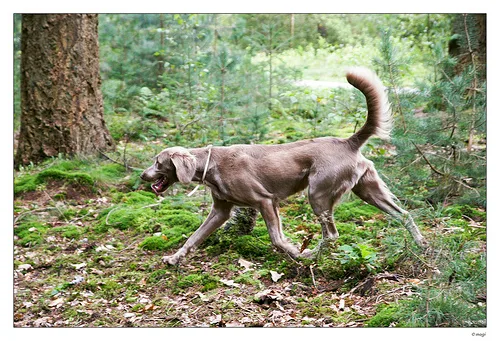
Long-haired Weimaraner
Hunting, tracking, retrieving, pointing, watchdog, guarding, search & rescue, agility.
- Origin
- Germany
- Size
- Large
- Height · Male
- 59–70 cm
- Height · Female
- 57–65 cm
- Weight · Male
- 30–40 kg
- Weight · Female
- 25–35 kg
- Life expectancy
- 10–13 years
- Litter
- 5–7 puppies
- FCI
- FCI group 7 · 7 · n.º 99
- AKC
- Non-Sporting Group · #29
Traits
Activity
Social
At home
Care
Training
Guarding
Temperament
The Weimaraner is happy and cheerful, highly intelligent and loving. They can be very willful and opinionated. This breed exhibits a truly unique personality. They are passionate and reliable. The Weimaraner prefers to live inside as a member of the family. They require companionship and attention and do not like to be left alone for long periods of time. This breed gets along well with other dogs but not cats. They are not recommended for very young children or the elderly as they could easily knock them down. The Weimaraner is brave and loyal.
History
There are numerous theories regarding the origin of the Weimaraner Pointing Dog. Only so much is certain : That the Weimaraner, which at that time still contained a great deal of liam hound blood (« Leithund ») was already kept at the Weimar court in the first third of the 19th century.
In the middle of the century, before pure breeding was started, breeding was mainly in the hands of professional hunters and game keepers in central Germany, mostly in the regions round Weimar and in Thuringia. As the days of the liam hounds passed, the dogs were crossed with the « Hühnerhund » and breeding was continued with this cross. From about 1890 on, the breed was produced according to a plan and regarded as suitable for registration in a stud book. Apart from the short-haired Weimaraner, a long-haired variety occurred, if only singly, since the turn of the century. Since being admitted to the stud book, the Weimaraner has been pure bred, remaining mostly free from crosses with any other breeds, in particular, Pointers. Therefore the Weimaraner is likely to be the oldest German « pointing » breed, which has been pure bred for about a hundred years.
Care
Daily strenuous exertion is a must for the Weimaraner. He needs to stretch his legs, run and explore in a large, safe area. As a social dog, he does best when he can divide his time between indoors and out. Coat care is minimal: occasional brushing to remove dead hair.
The Weimaraner requires strenuous exercise and stimulation. They love to play ball, romp, hike, and hunt. They must have room to roam and be given many opportunities to release their energy. Therefore, a large yard is preferred and is best for them. They do not kennel well and are not a breed for owners who lead sedentary lifestyles. The Weimaraner must be given sufficient exercise to prevent them from becoming bored, barking excessively, or being destructive.
Exercise, job or activity, socialization and training.
Training
The training must be firm and consistent because of its tendency to do anything it wants, but is eager to make pleasure to its master and will be not very difficult to train.
Coat & grooming
At the short hair variety, a casual brushing with a rubber brush is enough. At long hair variety the brushing and the combing must be made regularly.
Fun facts
The Weimaraner has a very fine sense of smell. Quite a hardy breed. Hip dysplasia has been reduced to only 8 percent through conscientious breeding, but it is still advisable to buy only from OFA certified stock. Prone to hypertropic osteodystrophy (too r