Dogs
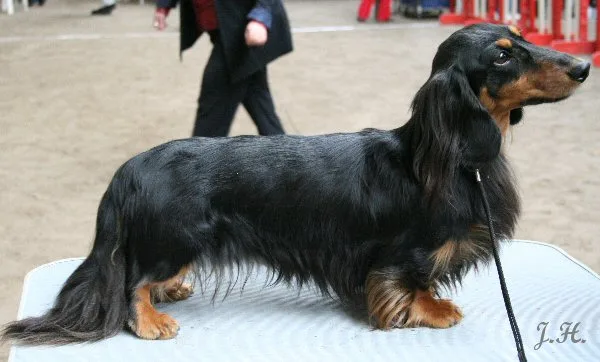
Rabbit Long-haired Dachshund
Other names: Teckel, Cão Salsicha, Weiner Dog ,Sausage Dog, Normalgrosse Teckel
Hunting, tracking, watchdog, performing tricks.
- Origin
- Germany
- Size
- Toy
- Height · Male
- 26–28 cm
- Height · Female
- 26–28 cm
- Weight · Male
- 3.6–5 kg
- Weight · Female
- 3.6–5 kg
- Life expectancy
- 12–14 years
- Litter
- 3–4 puppies
- FCI
- FCI group 4 · 4 · n.º 148
- AKC
- Hound Group · #5
Traits
Activity
Social
At home
Care
Training
Guarding
Temperament
Friendly by nature, neither nervous nor aggressive, with even temperament. Passionate, persevering and fast hunting dog with an excellent nose.
History
The Dachshund, also called Dackel or Teckel, has been known since the Middle Ages. From the « Bracken », dogs were constantly bred which were specially suitable for hunting below ground. From these short legged dogs, the Dachshund evolved and was recognised as one of the most versatile and useful breeds of hunting dogs. He also has excellent achievements above ground, hunting while giving tongue, searching and tracking wounded game. The oldest Club devoted to the breeding of Dachshunds is the « Deutsche Teckelklub » e.V., founded in 1888.
For decades the Dachshund has been bred in three sizes (Teckel, Miniature Teckel and Rabbit Teckel) and in three different kinds of coat (Smooth-haired, Wire-haired and Long-haired).
Care
Although Dachshunds are active, their exercise requirements can be met with moderate walks on leash and games in the yard. The Dachshund is amenable to city life or apartment living, but he is still a hunter at heart and enjoys forays into the wilds. The smooth coat requires minimal grooming. The long coat requires brushing or combing once or twice weekly and occasional trimming of stray hairs. The wire coat requires brushing or combing about once a week, with occasional trimming of stray hairs and stripping to remove dead hair twice a year.
The Dachshund can be lively and vivacious, however he does not need much exercise. A short walk per day would suffice for this short-bodied breed. The Dachshund tends to tire out easily so any exercise provided should be given at different times rather than one long walk. This breed is prone to back problems so high jumping and/or running should never be allowed.
Grooming, socialization.
Training
The training of this dog must be made by a person with experience and preferably within a training session because it is a dog which has tenfencies of domination and an independent thinking. But with patience, with a positive, firm, consequent attitude, withoit being too severe (it suffers if it is punished) good result can be obtained and it learns a lot, even if it will not listen blindlyalwaysthe commands. It needs exercise, walks, to run (the man should take care, because it can run if appears something which incites its hunter instincts) to keep its shapes.
Coat & grooming
The fur of this dog must be trimmed 2-3 times a year. The claws should be cut very short. Most of these dogs have the tendency to eat more, becoming obese. Ideal for them is to have 6,5-7 kg but they can arrive to 14 kg. An obese dog is a sick dog. Because of the very long spine they can have problems at the disks level between vertebras. They should not be allowed to climb stairs, to jump on a chair or to become obese. It is recommend using a mini harness instead of a dog-collar to protect the spine.